
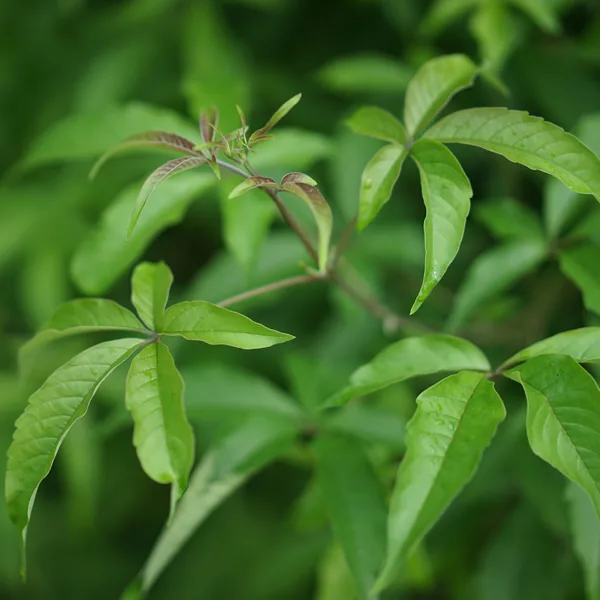
Overview & identification
Lagundi is a large, branched shrub reaching a height of 5 m. The leaves have five distinctly stalked leaflets arranged palmately, with the three middle leaflets longer than the other two. Each lance-shaped leaflet measures 4-10 cm long, hairy beneath, and pointed at both ends. The leaves are aromatic when crushed. The flowers are small, blue, and borne on terminal panicles 10-20 cm long. The fruits are small, black, and round.
It grows wild in uplands, roadsides, waste places, and thickets at low and medium elevations.
Local names
dabtan (If.); dangla (Ilk.); eagundi (Ak.); kalipapa-madam (Mag.); kamalan (Tag.); limo-limo (Ilk.);limpapa (Sul.); lingei (Bon.); lingolingo (Ilk.); mapugay (Sul.); molrei-oso (Sul.); sugarai (Bag.); tugas (S.L. Bis.); five-leaved chaste tree (Eng.); legundi (Bru.); trasiet (Cam.); ai tuban, lagundi laut laki laki (Ind.);‘sa khang' (Lao PDR); laggundi, leban, kulim papa (Mal.); kyaungban-gyi, kyetyo (Mya.); horse shoe vitex (Sin.); ko-no-ka-mo, kuning (Thai.); ngu trao, noong kim chan chim (Viet.)
Traditional uses
For fever, headache, cough, asthma (leaves)
Phytochemical composition
Isolated for bronchodilation (in vivo) Iridoids - agnuside, lagundinin, mussaenosidic acid, 2'-p-hydroxybenzoyl mussaenosidic acid, 6'-p-hydroxybenzoyl Flavonoids - casticin, luteolin, chrysoplenol D, isoorientin, parahydroxybenzoic acid
Isolated for anti-inflammatory action (in vitro, inhibition of chemotaxis, phagocytosis, and complement activation) Irridoids - lagundinin, 2'-p-hydroxybenzoyl mussaenosidic acid Flavonoids - casticin, chrysoplenol D
Antimicrobial (in vitro) Vitexilactone, isoorientin - C. albicans, A. niger, S. aureus & P. aeruginosa Flavone - 5,7,4'-trihydroxy-3'-beta-glucoronic acid methyl ester, 2'-p-hydroxybenzoyl mussaenosidic acid - T. mentagrophytes, C. neoformans
Hepatoprotective (in vitro) Negundoside - 2'-p-hydroxybenzoyl mussaenosidic acid
Anti-cancer activity (in vitro) Flavonoids - casticin, chrysoplenol D, chrysoplenetin
Clinical evidence
A randomized, double-blind, placebo-controlled trial was performed to evaluate lagundi (vitex negundo L.) tablets for the control of non-bacterial cough in children. Forty-three patients were randomized to either lagundi tablets (300 mg TID for children 10 years old and below, 600 mg TID for >10 years) or identical placebo tablets on the same regimen. Evaluations were made on Day 0, 3, 6, and 9 of subjective and objective measures of clinical response, and measurements of pulmonary function of cooperative children. The results showed that lagundi significantly improved subjective assessments of cough frequency and sputum color in older children (7 years old). In younger children (>7 years old), lagundi was no better than placebo regarding the subjective clinical parameters used. No side-effects were reported, and the tablet was acceptable in its taste and smell.
Forty otherwise healthy asthmatics participated in a randomized double-blind comparative study between lagundi tablets and the comparator drug theophylline. The patient profile of both treatment groups and the baseline parameters of both groups were also comparable. Results showed that both lagundi at 15 mg/kg/dose every 8 hours and theophylline at 3 mg/kg/dose every 8 hours produced significant bronchodilation over time. Side effects reported in the lagundi group were vomiting, desquamation of the skin over the palms, and increased frequency of urination. In the theophylline group, the side effects reported were nausea, vomiting, cold sweats, palpitations, tremors, headache, and epigastric pain. Overall, lagundi displayed significant bronchodilating effects.
A randomized, double-blind clinical trial was performed involving 76 patients with mild or moderate cough who were assigned to either lagundi at 600 mg/dose three times a day or equivalent tablets and placebo. Results showed that: lagundi therapy in patients with moderate cough resulted in a significant increase in Peak Expiratory Flow Rate (PEFR) and a decrease in respiratory rate by the 6th day compared to placebo. In patients with mild cough, there was disappearance of phlegm. Relief of dyspnea in 87.5% of the lagundi compared to 66.7% in the placebo group. For patients with moderate cough, by the 9th day, the frequency of cough and character of phlegm showed 81% for both parameters in lagundi and 75% for both parameters in the placebo group. Global evaluation for poor response showed only 6.6% in the lagundi group and 26% poor response in the placebo group. Adverse effects were comparable in both groups.
NIRPROMP performed Phase 1, 2, and 3 clinical trials to evaluate the efficacy and safety of the lagundi tablet versus placebo, and separate Phase 1, 2, and 3 clinical trials were performed for the lagundi syrup. These are contained in a separate Technology Transfer Document, which involved more than 400 patients with cough of non-bacterial origin wherein lagundi decreased the frequency of cough, increased the PEFR, and higher rates of clinical improvement.
There are few early-treatment medicines for mild COVID-19. This research examined the efficacy and safety of Lagundi (Vitex negundo) tablets and syrup (NIRPROMP_IHM formulation) in mild COVID-19-positive patients without comorbidities. This was a two-stage multicenter, parallel, randomized clinical study. Stage 1 was a dose-finding trial, while Stage 2 was an efficacy trial comparing the stage 1 dosage to placebo. Symptom ratings, clinical recovery time, illness progression, GES, and RT-PCR time to negative were outcome measures. Lagundi and placebo were administered for 10 days. For Stage 1, time to recovery and global assessment scores were similar for the standard and high dose groups (n=75). Standard dosage was used for stage 2. Except for BMI, the standard dose (Lagundi 600mg three times a day) (n=101) and the placebo (n=99) had similar baseline characteristics in stage 2. Compared to the placebo group, Lagundi's standard dose resulted in substantially lower total symptom scores (8.0, 95%: CI: 2.62) and anosmia scores (4.17, 95%: 1.98) at the endline, indicating a better response. Other symptom scores were lower in Lagundi but not statistically significant. Physician- and patient-rated GES ratings were higher for Lagundi than placebo, suggesting better alleviation, but they were not statistically significant. RT PCR found no significant changes in mean cycle threshold values on days 4, 8, and 12 between Lagundi and placebo. The two groups had similar mean recovery times. No significant difference was seen in intervention and placebo adverse events.
Dosage & preparation
Not yet documented in this entry. Pending source development and editorial review.
Safety
Not yet documented in this entry. Pending source development and editorial review.
Toxicity
Not yet documented in this entry. Pending source development and editorial review.
Contraindications
Not yet documented in this entry. Pending source development and editorial review.
Geographic distribution
Not yet documented in this entry. Pending source development and editorial review.
Regulatory status
Not yet documented in this entry. Pending source development and editorial review.
Conservation status
Not yet documented in this entry. Pending source development and editorial review.
Intellectual property
Not yet documented in this entry. Pending source development and editorial review.
Market information
Not yet documented in this entry. Pending source development and editorial review.
References
Dayrit F, Macahig RA. Encyclopedia of Common Medicinal Plants of the Philippines, Vol 1. Quezon City, Philippines: Philippine Institute of Traditional and Alternative Health Care, 2014.
Dans LF, Maramba NPC, How CH, Castaneda C, Alava H. The Efficacy, Safety, and Acceptability of Lagundi (Vitex negundo) Tablets in Non-Bacterial Cough in Children. Philippine Journal of Pediatrics 1989; 38 (1): 29-42.
Chu R. The Effect of “Lagundi” (a local herb) Tablets on Bronchial Asthma in Adults: Randomized Double-blind study with Theophylline. The Filipino Family Physician 1988; 26 (1): 1-10.
Cortes-Maramba NP, Dans LD, De Leon D, Ramos SP, Del Rosario WA, Aquino HF. Clinical Trial of vitex negundo Tablet as Antitussive in Lagundi (vitex negundo L.) Monograph, Technical Report Series no. 6. Philippine Council for Health Research, 1989.
Cortes-Maramba NP, Ramos S, Dancel P, Esteban A. Phase 1 Clinical Trial: Randomized Single-Blind Study of vitex negundo L (Lagundi) Syrup with Placebo and Bromhexine Among Pediatric Patients with Acute Cough of Mild to Moderate Severity. in: Lagundi Syrup Technology Transfer Document. National Integrated Research Program on Medicinal Plants, Philippine Council for Health Research and Development, 1999.
Cortes-Maramba NP, Ramos S, Bengco EO, Daquio-Sy F. Phase 2 Clinical Trial: Randomized Single-Blind Study of vitex negundo L. (Lagundi) Syrup Among Pediatric Patients with Acute Cough of Moderate Severity. in: Lagundi Syrup Technology Transfer Document. National Integrated Research Program on Medicinal Plants, Philippine Council for Health Research and Development, 1999.
Purificacion J, De Leon D, Cortes-Maramba NP. Phase 2 Clinical Trial: Randomized Single-Blind Study of vitex negundo L. (Lagundi) Syrup Among Pediatric Patients with Acute Cough of Moderate Severity. in: Lagundi Syrup Technology Transfer Document. National Integrated Research Program on Medicinal Plants, Philippine Council for Health Research and Development, 1999.
Badiola E. Phase III Multicenter Clinical Study of vitex negundo L. (Lagundi) Syrup Versus Placebo on Pediatric Patients with Acute Cough of Moderate Severity. in: Lagundi Syrup Technology Transfer Document. National Integrated Research Program on Medicinal Plants, Philippine Council for Health Research and Development, 1999.
Cortes-Maramba NP, Purificacion J. Phase III (1997) Multicenter Clinical Trial of vitex negundo L. (Lagundi) Syrup vs Placebo Among Pediatric Patients with Cough of Moderate Severity. in: Lagundi Syrup Technology Transfer Document. National Integrated Research Program on Medicinal Plants, Philippine Council for Health Research and Development, 1999.
Cortes-Maramba NP, Purificacion J. Phase III (1998) Multicenter Clinical Trial of vitex negundo L. (Lagundi) Syrup vs Placebo Among Pediatric Patients with Cough of Moderate Severity. in: Lagundi Syrup Technology Transfer Document. National Integrated Research Program on Medicinal Plants, Philippine Council for Health Research and Development, 1999.
Maramba-Lazarte CC, Cerrado JP, Purificacion J, Heredia SC, Bagaoisan DM, Elio RT, Castro MC, Tolosa EN, Velasco JM, Bautista-Palacpac
Additional source material
Original sections retained from the supplied archive.
Part Used
Leaves
Maintenance
Watering is done every day during the first few weeks of the transplant. When the plants are established, they can be watered at 10-14 days intervals through furrow irrigation. Mulching with rice straw, dried leaves, or grass trimmings helps conserve moisture around the plants. The trimmings are spread around the plants 5-7 cm thick. Eventually, the mulch decomposes and gets incorporated into the soil, making it fertile.
Weeding is done regularly prevent weeds from competing with lagundi for water, light, space, and nutrients and to prevent pests and disease build-up. Pests of lagundi include weeds, rodents, insects such as leaf folders, chrysomelid beetles, lace bugs, cutworms, leaf miners, leafhoppers, and gall mites; and diseases such as Cercospora leaf spot, circular leaf spot, and leaf blight.
Research source file
h_meds_w_nirpromp_val_lagundi.html
Quality Specifications
As fresh plant material Lagundi leaves should be fresh and green with no unwanted odor present except that of the medicinal plant (contains volatile constituents); average size and shape of leaf maturity; absence of unwanted plant parts and contaminants such as (a) brownish black decayed leaves, (b) parts of other plants, (c) insects and/or insect parts and excreta; absence of gross dirt.
As dried plant material Greenish brown to brownish-black leaves; no unwanted odor except that of the volatile constituent of lagundi; absence of damp leaves; average size and shape of leaf maturity; absence of contaminants as in the fresh plantmaterial; of brittle feel; with moisture content of 10% or less.
Preparation available in the market Lagundi Tablet: 300 mg and 600 mg Lagundi Syrup: 300 mg/5mL and 600 mg/5mL Non-Clinical Studies
Toxicity Oral LD50-103 g/kg in mice
Mutagenicity Results from a series of Rec assay and Ames test on powder, tablet and syrup preparations of vitex negundo L. indicate that it does not induce base-pair and frameshift mutations.
Clastogenicity Results from a series of micronucleus test on powder, tablet, and syrup preparations of vitex negundo L. indicate that it does not induce DNA damage and chromosomal aberrations.
Bioassay Cough chamber studies confirm the therapeutic potential of lagundi leaf preparation. Lagundi leaves decoctions to antagonize acetylcholine-induced supramaximal contractions of the rat duodenum. This antagonism is dose-related and is consistent in more than 200 trials.
Propagation and Field Planting
Lagundi can be propagated by basal or terminal stem cutting. For basal cutting, pencil-size, leafless, hardwood stem cuttings of approximately 20 cm long with at least three nodes are used. Basal stem cuttings are planted in 10 cm x 15 cm polyethylene bags (one cutting/bag) with a potting mixture of a 1:1:1 ratio of garden soil, compost, and river sand. The planted cuttings are placed in a shaded area and are watered as needed. Basal stem cuttings will root in 1 month.
The uppermost softwood parts of the stem (10-15 cm long) are used as propagating materials for terminal stem cuttings. To enhance root formation, they are soaked in 200 ppm indole-3-butyric acid (IBA) prior to insertion in a mist bed made of layers of gravel (bottom layer), volcanic cinder (middle layer), and fine sand (top layer). Terminal stem cuttings root in 1 month after insertion. Rooted cuttings are transplanted in polyethylene bags size 10 cm x 15 cm with the same potting mixture as the basal cuttings and are likewise treated as basal cuttings.
Once rooted, stem cuttings undergo a hardening process for 7-10 days prior to field transplant. They are gradually exposed to strong sunlight, and watering is withheld without reaching the permanent wilting point. Hardening results in hardy plant tissues, which are thicker and less succulent. It acclimatizes the plants to the harsh environment prior to field transplant.
After hardening, they are transplanted in the field in an east-to-west direction with a planting distance of 1.0 m x 1.5 m. Lagundi does not need thorough tillage or land preparation as long as there are no weeds immediately around the plants. Transplanting is preferably done at the start of the rainy season, but it can also be done during summer when the sky is overcast or in the late afternoon (around 4 pm)to avoid transplant shock.
Harvesting and Postharvest Handling
Lagundi leaves are harvested 7-8 months after the initial planting of cuttings. Subsequent harvests are done every 3-5 months thereafter. Lagundi is pruned after every leaf harvest.
Downloadable materials
No plant-specific downloads have been added yet. Browse the resource library ↗