
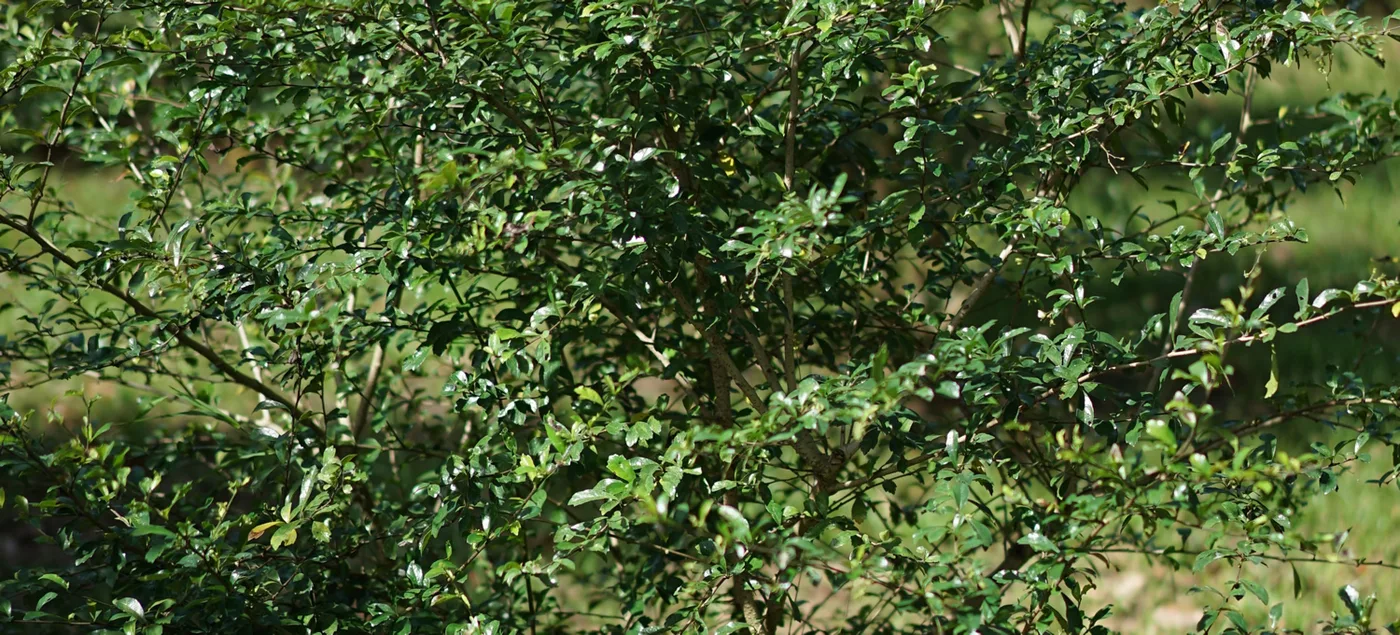
Overview & identification
This is a beautiful shrub or small tree with many erect branches. Leaves are alternate, sometimes two or three arising from a common point; upper surface is dark green and glossy, coarse to touch, 0.5-4 cm long, 0.5-1.5 cm wide, variable in shape and margin but generally obovate. Flowers are axillary, one to four from a common stalk; the corolla is white. Fruit is yellow-orange when ripe, 4-5 mm in diameter, and succulent. It contains a seed.
It is common in thickets and secondary forests at low and medium altitudes. It is sometimes cultivated as an ornamental plant. The young tops are sometimes used as tea.
Local names
tsaang gubat, cha, chaang-bundok, talibunog, kalimumog, kalamoga, kalimong (Tag.); alangitngit, mangit (Tag., Bis.); putputai (Bik.); alangit (Bis.); balingsua (C. Bis.); buntaitai, mara-mara (P. Bis.); buyobuyo, buyok-buyok, santing (Sul.); gari (Bag.); icha, icha-nga, atap, icha-ti-bakir, itsa (Ilk.); kalimumug (Mag.); mara-mara (Bik, S. L. Bis.); maratia (Ibn.); palupo (Iv.); putputai (Bik.); Philippine tea tree, Fukien tea tree, scorpionbush, wild tea (Eng.); kinangan, serut lanang, pinaan (Ind.); khoi cheen, chaa yeepun, chaa (Thai.); kim li[ee]n, c[uf]m r[uj]n, b[uf]m r[uj]n (Viet.)
Traditional uses
For diarrhea and stomach pain (leaves)
Phytochemical composition
Characteristic compounds Benzoquinones - allomicrophyllone, microphyllone, cyclomicrophyllone, dehydromicrophyllone
Anti-inflammatory compound (in vitro) Rosmarinic acid
Anti-mutagenic compound (in vitro) 4-hydroxy-7,8,11,12,15,7',8',11',12',15'-decahydrobeta, gamma-carotene
Clinical evidence
NIRPROMP has performed Phase 1, 2, and 3 clinical trials, including more than 300 patients, to evaluate the efficacy and safety of tsaang gubat for gastrointestinal and biliary colic. Results show that tsaang gubat is as efficacious as dicycloverine for these conditions. These clinical trials were used by the licensees for registration of the product with the Philippine Food and Drug Administration as an herbal medicines.
Dosage & preparation
Not yet documented in this entry. Pending source development and editorial review.
Safety
Not yet documented in this entry. Pending source development and editorial review.
Toxicity
Not yet documented in this entry. Pending source development and editorial review.
Contraindications
Not yet documented in this entry. Pending source development and editorial review.
Geographic distribution
Not yet documented in this entry. Pending source development and editorial review.
Regulatory status
Not yet documented in this entry. Pending source development and editorial review.
Conservation status
Not yet documented in this entry. Pending source development and editorial review.
Intellectual property
Not yet documented in this entry. Pending source development and editorial review.
Market information
Not yet documented in this entry. Pending source development and editorial review.
References
Dayrit F, Macahig RA. Encyclopedia of Common Medicinal Plants of the Philippines, Vol 1. Quezon City, Philippines: Philippine Institute of Traditional and Alternative Health Care, 2014.
Villasenor IM, Canlas AP, Faustino KM, Plana KG. Evaluation of the Bioactivity of Triterpene Mixture Isolated from Carmona retusa (Vahl) Masam Leaves. Journal of Ethnopharmacology 2004; 92:53-56.
Cortes-Maramba NP and Purificacion, JM. National Integrated Research Program on Medicinal Plants. Phase III - Antispasmodic Effect of Carmona retusa (Vahl) Masam (Tsaang Gubat) Tablet Compared with Dicycloverine Among Patients with Mild, Moderate, and Severe Gastrointestinal Colic. In: Tsaang gubat Technology Transfer Document. Philippine Council for Health Research and Development, 2008.
Cortes-Maramba NP and Purificacion, JM. National Integrated Research Program on Medicinal Plants. Phase III - Antispasmodic Effect of Carmona retusa (Vahl) Masam (Tsaang Gubat) Tablet Compared with Dicycloverine Among Patients with Mild, Moderate and Severe Biliary Colic. In: Tsaang gubat Technology Transfer Document. Philippine Council for Health Research and Development, 2008.
Cortes-Maramba NP and Purificacion, JM. National Integrated Research Program on Medicinal Plants. Phase II - Antispasmodic Effect of Carmona retusa (Vahl) Masam (Tsaang Gubat) Tablet Compared with Dicycloverine Among Patients with Mild, Moderate, and Severe Biliary Colic. In: Tsaang gubat Technology Transfer Document. Philippine Council for Health Research and Development, 2008.
Cortes-Maramba NP and Purificacion, JM. National Integrated Research Program on Medicinal Plants. Phase II - Antispasmodic Effect of Carmona retusa (Vahl) Masam (Tsaang Gubat) Tablet Compared with Dicycloverine Among Patients with Mild, Moderate, and Severe Gastrointestinal Colic. In: Tsaang gubat Technology Transfer Document. Philippine Council for Health Research and Development, 2008.
Cortes-Maramba NP and De Leon D. National Integrated Research Program on Medicinal Plants. Phase I - Open Clinical Trial of Carmona retusa (Vahl) Masam (Tsaang Gubat) Tablet in Patients with Acute Onset Diarrhea and Intestinal Colic. In: Tsaang gubat Technology Transfer Document. Philippine Council for Health Research and Development, 2008.
Additional source material
Original sections retained from the supplied archive.
Part Used
Leaves
Maintenance
Watering is done every day during the first few weeks of the transplant. When fully recovered or established, tsaang gubat can be watered at 10-14 days intervals by furrow irrigation.
Tsaang gubat can be mulched with rice straw, dried leaves, or grass trimmings. This can benefit the plants as it prevents water loss and rejuvenates the fertility of the soil. The trimmings are spread around the plants 5-7 cm thick and are left to decompose and get incorporated into the soil, making the soil less compact and fertile.
Weeding is done regularly. Weed control methods are: light plowing between rows, cutting weeds close to the ground by brushcutting, and ring weeding where weeds, 40-45 cm around the plants, are up-rooted or pulled up. Fertilizer application is based on soil analysis. If the field soil is fertile, or when the co-existing vegetation, like weeds/grasses, does not exhibit yellowing or chlorosis, the application of fertilizer is unnecessary.
Pests of tsaang gubat include leaf miners, which are larvae of leaf-mining insects such as moths, sawflies, and flies that form feeding tunnels and deposit frass or droppings that which cause unsightly brown blotches; insects and mites with their feeding and egg-laying activities that cause the plants to produce more plant hormones, thereby, increasing localized plant growth resulting to the formation of galls; leaf hoppers with their chewing mouthparts; and weeds such as Mimosa pudica (makahiya), Centrosema sp. (butterfly pea), Convolvulus sp. (bindweed) and Coccinia grandis (baby watermelon). Using pesticides to control pests is not recommended at the moment due to lack of studies on their effects on the plant's safety and efficacy. The present recommendation is to practice clean culture through thorough tillage operations that will destroy the hiding and breeding grounds of insects and diseases and to select planting materialsmaterial that are pest- and disease-free carefully.
Botanical Name
Ehretia microphylla Lam. (Fam. Boraginceae)
Scientific Synonyms
Carmona heterophylla Cav. Carmona microphylla (Lam.) G. Don Carmona retusa (Vahl.) Masam Cordia retusa Vahl. Ehretia heterophylla Spreng.
Non-Clinical Studies
Toxicity Oral LD50-63.1 g/kg in mice
Mutagenicity Results from a series of Rec assays and Ames tests on powder and tablet preparations of Carmona retusa indicate that it does not induce base-pair mutations and frameshift mutations.
Clastogenicity Results from a series of micronucleus test on powder and tablet preparations of Carmona retusa indicate that it does not induce DNA damage and chromosomal aberrations.
Bioassay The effectiveness of tsaang gubat tablets was determined using the charcoal tracing method. Results show that the percentage distance traveled by activated charcoal on the intestine of Male Swiss mice receiving tsaang gubat was significantly higher than those receiving only normal saline solution.
In vivo studies Several preclinical research have been performed, including an in vivo murine model for analgesic activity and another for the anti-inflammatory activity of 100 mg/kg of tsaang gubat extract, while an in vitro model to evaluate the anti-diarrheal activity at 250 mg/kg of tsaang gubat extract. At a 100 mg/kg dose, the triterpene mixture exhibited 51% analgesic activity but only showed 20% anti-inflammatory activity. The tripertene mixture of tsaang gubat showed a 29% anti-diarrheal activity which increased to 55% at 250 mg/kg
Research source file
h_meds_w_nirpromp_val_ tsaang_gubat.html
Quality Specifications
As fresh plant material Tsaang gubat should be fresh green leaves with no unwanted odor present except that of the medicinal plant; average size and shape to that of leaf maturity; absence of unwanted plant parts and contaminants such as: (a) brownish black decayed leaves, (b) part of other plants, (c) insects and/or insect parts and excreta; absence of gross dirt.
As dried plant material Green leaves; no unwanted odor except that of the characteristic odor of tsaang gubat; absence of damp leaves; average size and shape of that of leaf maturity; absence of contaminants as in the fresh plant material; of brittle feel; with moisture content of 10% or less.
Preparation available in the market Tsaang Gubat Tablet, 250 mg Tsaang Gubat Tablet, 500 mg
Stability After one and a half years of storage at room temperature, tsaang gubat tablets were found to be physically stable. Results showed acceptable values for weight uniformity, hardness, friability, moisture content, and disintegration time. Bioassay using ED50 proved that these tablets are still safe and effective.
Propagation and Field Planting
Tsaang gubat is best propagated by terminal softwood stem cutting at 10-20 cm-length. To enhance and speed up root formation, the cuttings are dipped in 100 ppm indole-3-butyric acid (IBA) for 2-6 hours prior to insertion in the bed of soil and fine river sand (1:1) under intermittent mist. Softwood stem cuttings will root 15-30 days (93.3% rooting at 15 days and 100% rooting at 30 days) after insertion in a mist bed and can be transferred to 10 cm x 18 cm polyethylene bags with a potting medium consisting of garden soil and compost in a 2:1 ratio. The potted stem cuttings are placed in a partially shaded area until established. Two months after, the plants are ready for hardening and field transplant.
Hardening is done 7-10 days before field transplanting to acclimate the plants to the harsh field environment. Field transplanting is done early in the morning or late in the afternoon at a planting distance of 1 m x 1.5 m or a planting density of 6,666 plants/ha. A 2 m x 2 m planting distance (with a planting density of 2,500 plants/ha) can also give ample space.
Harvesting and Postharvest Handling
Tsaang gubat is pruned after every leaf harvest. First pruning (concurrent with first leaf harvesting) is done 7-8 months after the initial planting of cuttings. All subsequent pruning operations are done every 3-5 months thereafter.
Tsaang gubat leaves are harvested 7-8 months after the initial planting of cuttings. Subsequent harvests are done every 3-5 months thereafter. Concurrent with leaf harvesting is pruning. The branches are severed/pruned from the plants 75-100 cm from the ground by a bolo or clean pruning shears. Nitrogen fertilizer application usually follows every pruning operation to rejuvenate the plants and produce robust vegetative growth.
Downloadable materials
No plant-specific downloads have been added yet. Browse the resource library ↗